Skip to content

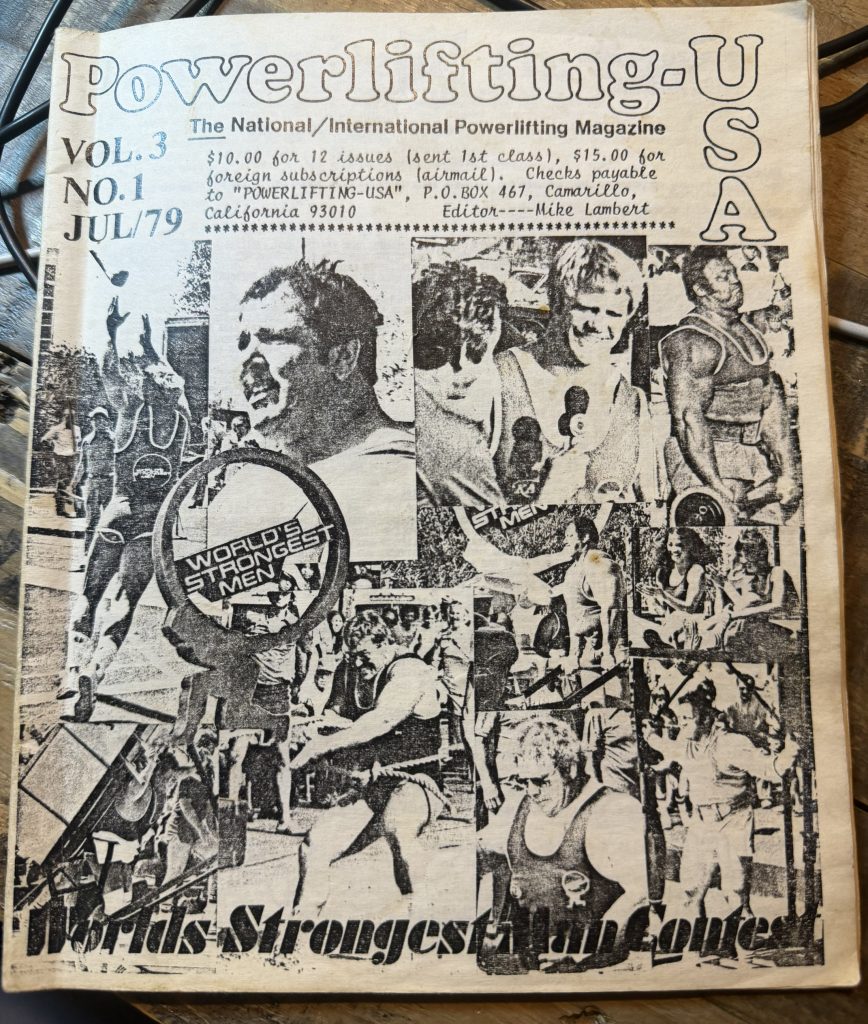
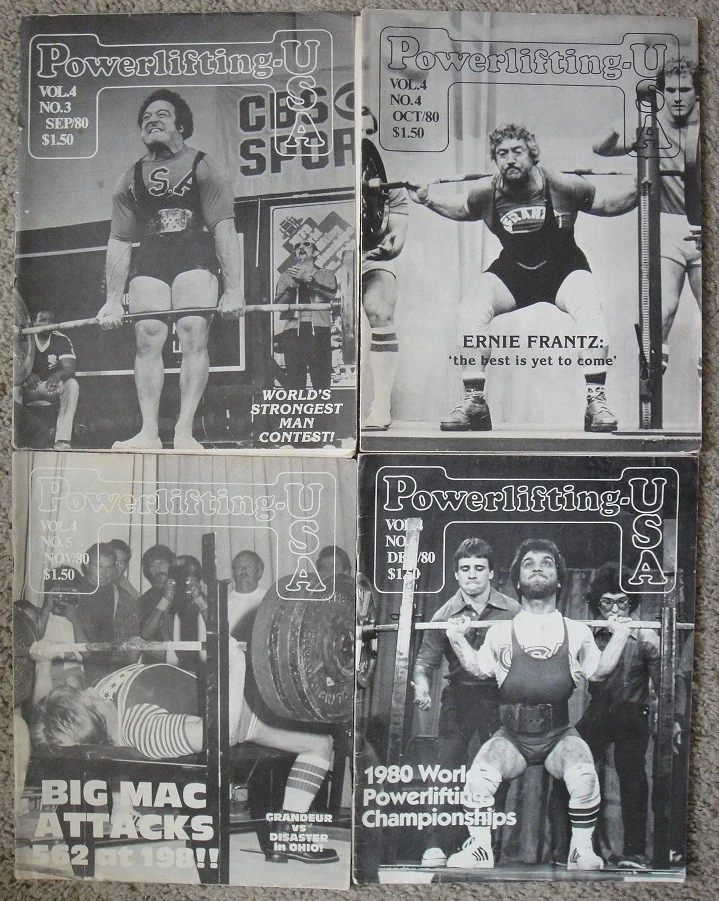
Powerlifting USA - July 1979 • Lessons from Dr. Squat [Fred Hatfield] & Dr. Ken Leistner
The font in these articles was so small that I needed my glasses to read these articles. It's amazing that Dr. Squat and Dr. Ken were writing articles before I was even born in 1975.
I used AI to enhance the articles and enlarge the font so hopefully you can enjoy them as well. I also pulled the text from the articles so read below and standby for a STRONG Life Podcast where I share these lessons with my own feedback, comments and experiences in relation to these articles.
Fred Hatfield, Dr. Squat
...renowned physiologist...and...world record holder...rather a unique combination, but simply facets of his many achievements. Dr. Fred Hatfield may be the most important man in powerlifting today. Right on the cutting edge between practice and theory, his viewpoint as an applied scientist and world-class competitor is unequaled.
A major series of training articles by Dr. Hatfield will appear in future issues of PL USA, followed by a book this fall, The Science of Powerlifting.
I am tremendously excited by the prospect of this valuable series of articles. Fred has put many pounds on the totals of those he has coached and guided. His theories are sound, and they work.
— MRL
The Basic Principles of Training
Frederick C. Hatfield, Ph.D.
University of Wisconsin
For years now, I have been observing the training regimens of the top powerlifters. This isn't surprising, as these men have traditionally served as the models for most powerlifters' training routines.
However, the most striking observation one is forced to accept is that many of these champions' routines appear to be very different from each other. One champion may advocate doing many sets of threes; another may do eights, light-to-heavy, heavy-to-light, pyramids, and a host of other variations.
Further, each has his pet supplementary exercises, many of which are commonly employed and many, too, which are strange beyond belief.
The aspiring champions, in an attempt to grasp the brass ring of success before the merry-go-round passes them by, adopt the champions' routines. Sometimes they are incorporated in total, and sometimes parts of them are used.
Success is achieved sometimes, and sometimes it is not. There appears to be only random, perhaps chance, gains made from the routines adopted from the champions.
One has to ask, then, why the champions are able to make such fantastic gains on their regimens while someone else cannot.
Might it be that when asked, the champion tells the interviewer what he perceives the interviewer wants to hear? My experience tells me that this is often the case.
Alternatively, might it be that the champion has ascended to a plateau of conditioning that is amenable to his peculiar regimen? And might it be that what's working for him may be totally unsuitable for the aspiring champion who not only possesses a different body and musculoskeletal system, but also a different level of conditioning?
Certainly.
While the champions' regimens are striking for their differences, they are just as striking for their similarities.
In every case that I have ever reviewed, a single similarity has consistently manifested itself: adherence to the basic principles of conditioning.
Exercise physiologists traditionally identify four basic principles of conditioning. There is a fifth which is currently in the theoretical stage, lacking substantial research support for its tenets.
These basic principles are as follows:
1. Isolation Principle
To maximally overload a muscle, it must either be isolated from all other muscle action (to avoid synergy "robbing" it of effect), or it must be the weakest muscle of those acting in the movement (to derive maximal overload benefits).
2. Overload Principle
All muscular changes, of whatever nature, are most efficiently derived by forcing adaptation through the application of stress in amounts greater than what the muscle is normally used to.
Thus, a continuum of overload exists, ranging from mild to severe. The healthy organism will benefit maximally from severe overload.
3. SAID Principle
Specific Adaptation to Imposed Demands simply means that the various mechanisms which comprise the musculoskeletal system must be stressed differentially to derive specific effects.
For example, the mechanisms involved in local muscular endurance are entirely different from those involved in power. They also respond to stress in different ways.
It is necessary to identify the best method of applying the appropriate stress to the appropriate mechanisms in order to derive the specific results that you are interested in achieving.
4. Simulation Principle
Sometimes referred to as the "specificity" principle, this basically means that a sport action or skilled movement must be performed with greater than normal resistance in order to derive usable strength in that movement.
Some scientists feel that the actual mechanisms involved are the neural pathways involved in the skill.
In common parlance, this is referred to as the "groove." By overloading the groove, the motor units involved in the sequence of the skill are facilitated to respond more efficiently, thereby increasing the effectiveness of the skilled movement.
5. The Disinhibition Theory
Rapidly gaining ground in the scientific community as a tenable concept, disinhibition involves the interface between the functioning of the mind and the proprioceptors of the muscular system.
Without becoming too technical, this interfacing works as follows:
The tremendous stretch placed on the muscles and tendons causes a defensive shutdown of the contracting muscle. The threshold at which shutdown occurs may be capable of being moved back through mind-control techniques, generally referred to as conditioning techniques.
There are many techniques to circumvent or alter the level at which shutdown occurs. Science is only beginning to understand this intriguing area.
As I said earlier, all of the great lifters have one aspect or another of these basic principles in common regarding how they train.
The reader is asked to review some of them and try to apply these principles to them. I believe you will be startled, as I was, by the remarkable similarities between them.
You will notice that each lifter applies them differently, but nonetheless they are being applied.
What great lifter, for example, does not apply the Isolation Principle? Witness the favorite supplemental exercises used. Most are designed to isolate a particular muscle that is important in a competitive lift.
All, of course, apply the Overload Principle, pushing the limits of muscular strength continually upward.
Each also spends time on the actual lifts, particularly prior to contests, so as to get the groove of the lift well embedded and consistent.
Lastly, I feel that one of the primary attributes of the great champions that I have observed is their ability to concentrate.
Whether they realize it or not—and I suspect they generally don't—such deep concentration is the apparent key to going beyond the normal range of pain tolerance in executing a record lift and in exceeding the normal range of muscular inhibition.
Something akin to "super strength" (no, gamma rays aren't involved!).
I have written a series of brief articles describing the methods by which each of the basic principles are traditionally applied in training, and they will be presented in future issues of Powerlifting USA.
Next month's issue will carry my article on the application of the SAID Principle, as I feel that of all the principles, it is the most misunderstood and the most misapplied.
There will also be an article on isokinetic training, as I believe such training is the single most important method of applying the Disinhibition Theory to power-increment training.
About the Author
Dr. Fred Hatfield is the coordinator of the weight training and conditioning programs at the University of Wisconsin – Madison.
Last year, at the "Postal" Pan-Ams, he broke three of four Pan-Am records in powerlifting.
This year, competing for the United States in the North American Powerlifting Championships, Dr. Hatfield broke the world record in the squat with a 722-pound lift in the 181-pound class.
He also erased Thomas's American record total with an 1,829-pound total, narrowly missing a third deadlift that would have given him the world record total as well.
Dr. Hatfield is currently working on a book entitled The Science of Powerlifting, scheduled for release near the end of summer.
He also has a book available entitled Personalized Weight Training for Fitness & Athletics: From Theory to Practice, published by Kendall/Hunt Publishing, Dubuque, Iowa.
============
============
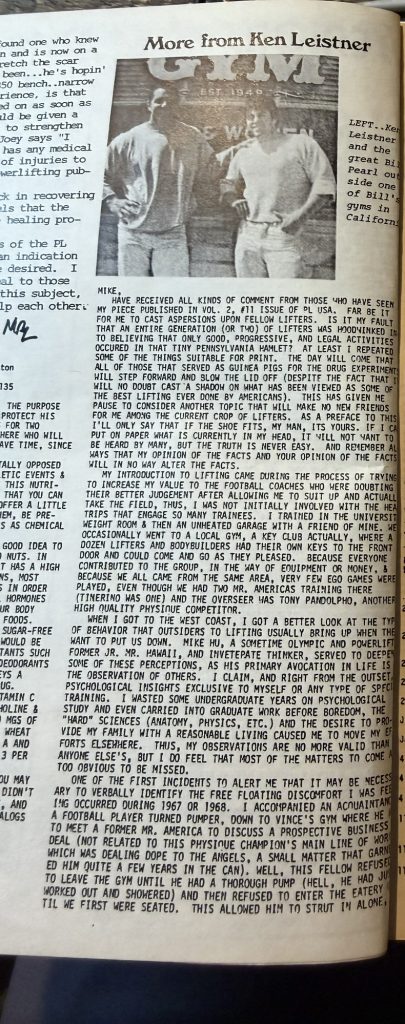
More from Ken Leistner
Mike,
Have received all kinds of comment from those who have seen my piece published in Vol. 2, #11 issue of PL USA. Far be it for me to cast aspersions upon fellow lifters. Is it my fault that an entire generation (or two) of lifters was hoodwinked into believing that only good, progressive, and legal activities occurred in that tiny Pennsylvania hamlet?
At least I repeated some of the things suitable for print. The day will come that all of those that served as guinea pigs for the drug experiments will step forward and blow the lid off (despite the fact that it will no doubt cast a shadow on what has been viewed as some of the best lifting ever done by Americans).
This has given me pause to consider another topic that will make no new friends for me among the current crop of lifters. As a preface to this I'll only say that if the shoe fits, my man, it's yours. If I can put on paper what is currently in my head, it will not want to be heard by many, but the truth is never easy. And remember always that my opinion of the facts and your opinion of the facts will in no way alter the facts.
My introduction to lifting came during the process of trying to increase my value to the football coaches who were doubting their better judgement after allowing me to suit up and actually take the field. Thus, I was not initially involved with the health trips that engage so many trainees.
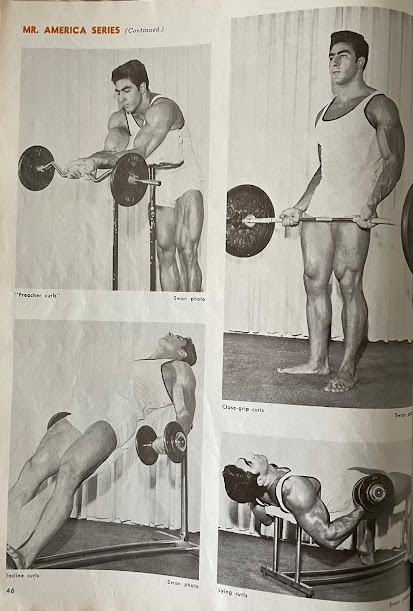
I trained in the university weight room and then an unheated garage with a friend of mine. We occasionally went to a local gym, a key club actually, where a dozen lifters and bodybuilders had their own keys to the front door and could come and go as they pleased. Because everyone contributed to the group, in the way of equipment or money, and because we all came from the same area, very few ego games were played, even though we had two Mr. Americas training there (Tinerino was one) and the overseer was Tony Pandolpho, another high quality physique competitor.
When I got to the West Coast, I got a better look at the type of behavior that outsiders to lifting usually bring up when they want to put us down. Mike Hu, a sometime Olympic and powerlifter, former Jr. Mr. Hawaii, and inveterate thinker, served to deepen some of these perceptions, as his primary avocation in life is the observation of others. I claim, and right from the outset, no psychological insights exclusive to myself or any type of specific training.
I wasted some undergraduate years on psychological study and even carried into graduate work before boredom, the "hard" sciences (anatomy, physics, etc.) and the desire to provide my family with a reasonable living caused me to move my efforts elsewhere. Thus, my observations are no more valid than anyone else's, but I do feel that most of the matters to come are too obvious to be missed.
One of the first incidents to alert me that it may be necessary to verbally identify the free floating discomfort I was feeling occurred during 1967 or 1968. I accompanied an acquaintance, a football player turned pumper, down to Vince's Gym where he was to meet a former Mr. America to discuss a prospective business deal (not related to this physique champion's main line of work, which was dealing dope to the Angels, a small matter that garnered him quite a few years in the can).
Well, this fellow refused to leave the gym until he had a thorough pump (hell, he had just worked out and showered) and then refused to enter the eatery til we first were seated. This allowed him to strut in alone...
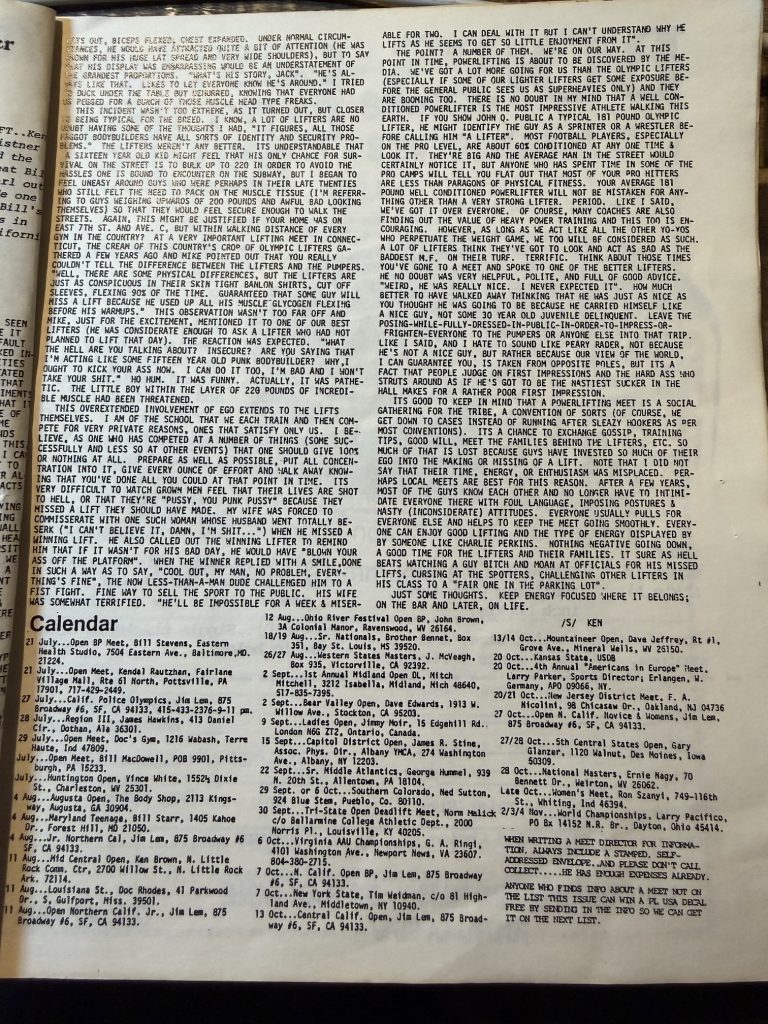
"Just Some Thoughts" — by Ken Leistner
...lays out, biceps flexed, chest expanded. Under normal circumstances, he would have attracted quite a bit of attention (he was known for his huge lat spread and very wide shoulders), but to say that his display was embarrassing would be an understatement of the grandest proportions. "What's his story, Jack." "He's always like that. Likes to let everyone know he's around." I tried to duck under the table but demurred, knowing that everyone had us pegged for a bunch of those muscle head freaks.
The incident wasn't too extreme as it turned out, but closer to being typical for the breed. I know, a lot of lifters are no doubt having some of the thoughts I had, "It figures, all those faggot bodybuilders have all sorts of identity and security problems."
The lifters weren't any better. It's understandable that a sixteen year old kid might feel that his only chance for survival on the street is to bulk up to 220 in order to avoid the hassles one is bound to encounter on the subway, but I began to feel uneasy around guys who were perhaps in their late twenties who still felt the need to pack on the muscle tissue (I'm referring to guys weighing upwards of 200 pounds and about as bad looking themselves) so that they would feel secure enough to walk the streets.
Again, this might be justified if your home was on East 7th St. and Ave. C, but within walking distance of every gym in the country? At a very important lifting meet in Connecticut, the cream of this country's crop of Olympic lifters gathered a few years ago and Mike pointed out that you really couldn't tell the difference between the lifters and the pumpers. "Well, there are some physical differences, but the lifters are just as conspicuous in their skin tight Banlon shirts, cut off sleeves, flexing 90% of the time. Guaranteed that some guy will miss a lift because he used up all his muscle glycogen posing before his warmups."
This observation wasn't too far off and Mike, just for the excitement, mentioned it to one of our best lifters (he was considerate enough to ask a lifter who had not planned to lift that day). The reaction was expected. "What the hell are you talking about? Insecure? Are you saying that I'm acting like some fifteen year old punk bodybuilder? Why, I ought to kick your ass now. I can do it too, I'm bad and I won't take your shit." Ho hum. It was funny. Actually, it was pathetic. The little boy within the layer of 220 pounds of incredible muscle had been threatened.
This overextended involvement of ego extends to the lifts themselves. I am of the school that we each train and then compete for very private reasons, ones that satisfy only us. I believe, as one who has competed at a number of things (some successfully and less so at other events) that one should give 100% or nothing at all.
Prepare as well as possible, put all concentration into it, give every ounce of effort and walk away knowing that you've done all you could at that point in time. It's very difficult to watch grown men feel that their lives are shot to hell, or that they're "pussy, you punk pussy" because they missed a lift they should have made. My wife was forced to commiserate with one such woman whose husband went totally berserk ("I can't believe it. I'm shit...") when he missed a winning lift.
He also called out the winning lifter to remind him that if it wasn't for his bad day, he would have "blown your ass off the platform". When the winner replied with a smile, done in such a way as to say, "Cool out, my man, no problem, everything's fine", the now less-than-a-man dude challenged him to a fist fight. Fine way to sell the sport to the public. His wife was somewhat terrified. "He'll be impossible for a week and miserable for two. I can deal with it but I can't understand why he lifts as he seems to get so little enjoyment from it."
The point? A number of them. We're on our way. At this point in time, powerlifting is about to be discovered by the media. We've got a lot more going for us than the Olympic lifters are booming too. There is no doubt in my mind that a well conditioned powerlifter is the most impressive athlete walking this earth.
If you show John Q. Public a typical 181 pound Olympic lifter, he might identify the guy as a sprinter or a wrestler before calling him "a lifter." Most football players, especially on the pro level, are about 60% conditioned at any one time and look it. They're big and the average man in the street would certainly notice it, but anyone who has spent time in some of the pro camps will tell you flat out that most of your pro hitters are less than paragons of physical fitness.
Your average 181 pound well conditioned powerlifter will not be mistaken for anything other than a very strong lifter. Period. Like I said, we've got it over everyone. Of course, many coaches are also finding out the value of heavy power training and this too is encouraging. However, as long as we act like all the other yo-yos who perpetuate the weight game, we too will be considered as such.
A lot of lifters think they've got to look and act as bad as the baddest M.F. on their turf. Terrific. Think about those times you've gone to a meet and spoke to one of the better lifters. He no doubt was very helpful, polite, and full of good advice. "Weird, he was really nice. I never expected it." How much better to have walked away thinking that he was just as nice as you thought he was going to be because he carried himself like a nice guy, not some 30 year old juvenile delinquent. Leave the posing-while-fully-dressed-in-public-in-order-to-impress-or-frighten-everyone to the pumpers or anyone else into that trip.
Like I said, and I hate to sound like Peary Rader — not because he's not a nice guy, but rather because our view of the world, I can guarantee you, is taken from opposite poles — but it's a fact that people judge on first impressions and the hard ass who struts around as if he's got to be the nastiest sucker in the hall makes for a rather poor first impression.
It's good to keep in mind that a powerlifting meet is a social gathering for the tribe, a convention of sorts (of course, we get down to cases instead of running after sleazy hookers as per most conventions). It's a chance to exchange gossip, training tips, good will, meet the families behind the lifters, etc.
So much of that is lost because guys have invested so much of their ego into the making or missing of a lift. Note that I did not say that their time, energy, or enthusiasm was misplaced. Perhaps local meets are best for this reason. After a few years, most of the guys know each other and no longer have to intimidate everyone there with foul language, imposing postures and nasty (inconsiderate) attitudes.
Everyone usually pulls for everyone else and helps to keep the meet going smoothly. Everyone can enjoy good lifting and the type of energy displayed by someone like Charlie Perkins. Nothing negative going down, a good time for the lifters and their families. It sure as hell beats watching a guy bitch and moan at officials for his missed lifts, cursing at the spotters, challenging other lifters in his class to a "fair one in the parking lot."
Just some thoughts. Keep energy focused where it belongs; on the bar and later, on life.
— Ken Leistner